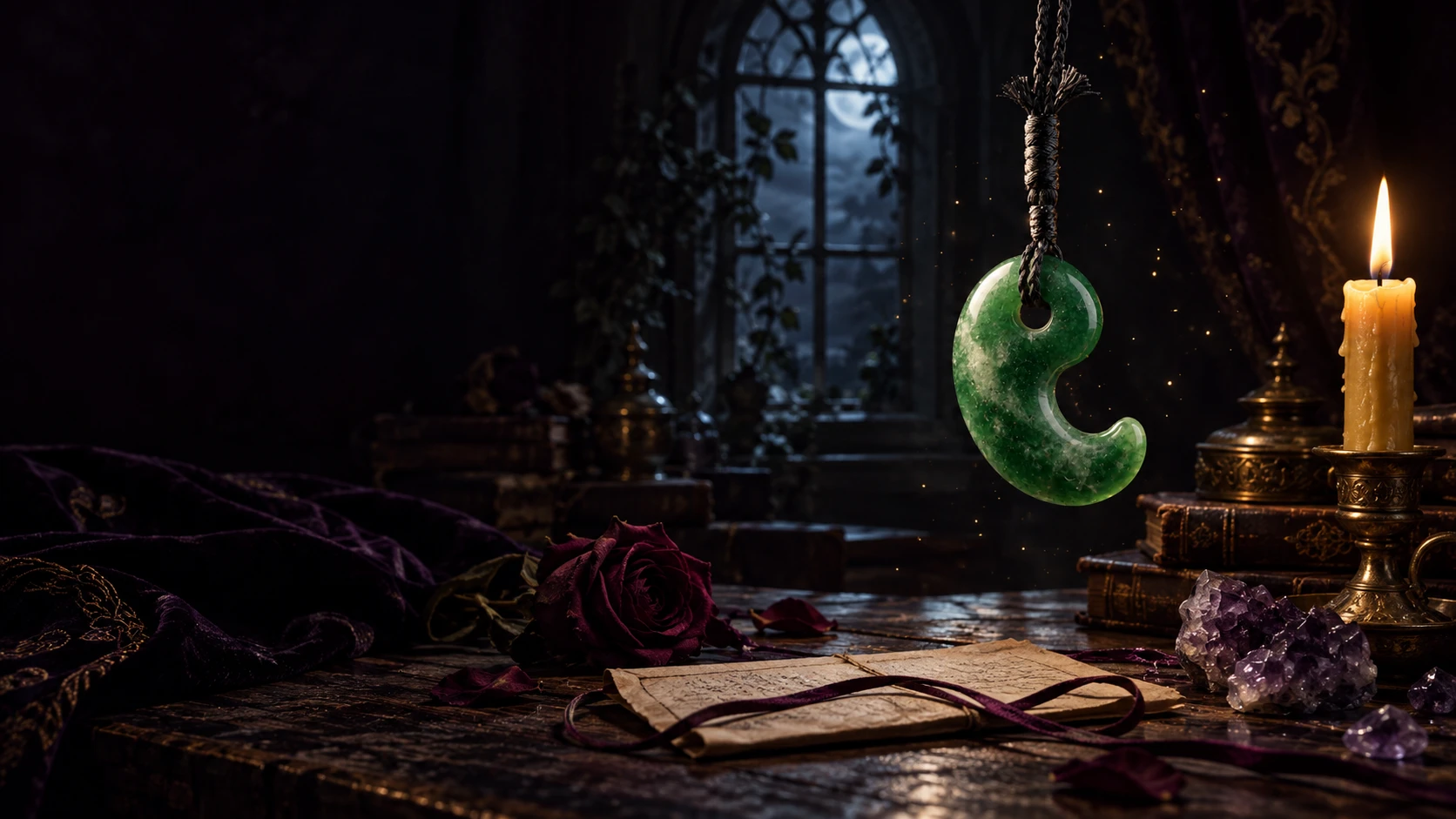
Five thousand years ago, before kanji, before tea, before silk,
the first artisans of this archipelago were already shaping jadeite.
Hisui (翡翠) is not merely a stone.
It is the material the gods reached for first — and the substance Japan recognised as its national mineral in 2016.
The Japanese word Hisui (翡翠) means jadeite. The two kanji that compose it — hi (翡) and sui (翠) — originally referred to the male and female kingfisher, a brilliantly iridescent bird whose feathers shift between green and blue depending on the light.
The ancients named the stone after the bird because both share a single quality: a green that lives, that moves with the light. Hisui is not a frozen colour. It breathes.
Long before the word arrived from China, Japanese hands had been working this stone for millennia. It already had its own meaning here: the stone that holds the kami. The stone the gods chose first.
Today, the word hisui appears in three distinct registers across Japanese life. In mineralogy, it names jadeite (硬玉) — the harder, rarer of the two minerals commercially called jade. In Shinto liturgy, it names the sacred substance of imperial regalia. In contemporary jewellery, it names the green amulet worn against the heart. All three meanings descend from the same 5,000-year root.
In the English-speaking world, "jade" is a single word that conceals two very different stones. The science separates them clearly: jadeite and nephrite are mineralogically distinct, with different chemistries, different geological origins, and different rarity. The hisui of Japan is, without exception, jadeite.
| Property | Jadeite (Hisui · 硬玉) | Nephrite (軟玉) |
|---|---|---|
| Composition | NaAlSi₂O₆ — sodium aluminium silicate (pyroxene group) | Ca₂(Mg,Fe)₅Si₈O₂₂(OH)₂ — calcium magnesium iron silicate (amphibole group) |
| Mohs Hardness | 6.5 — 7 | 6 — 6.5 |
| Density | 3.30 — 3.38 g/cm³ | 2.95 — 3.05 g/cm³ |
| Texture | Granular interlocking crystals — bright, translucent lustre | Fibrous interlocking crystals — softer, oilier appearance |
| Major Sources | Itoigawa (Japan), Myanmar, Guatemala, Russia | China (Hetian), Taiwan, Canada, Siberia, New Zealand |
| Rarity | Significantly rarer — accounts for under 5% of commercial jade | Far more abundant in the global trade |
| Status in Japan | National Stone of Japan (2016) | Not designated |
Jadeite displays a glassier, more vitreous shine than nephrite. Under strong light, fine jadeite reveals translucency with an inner glow that nephrite — being fibrous — diffuses into a softer, waxier sheen. Jadeite also rings with a brighter, higher-pitched tone when two pieces are struck together.
The distinction matters historically. For two thousand years before Japan's archaeologists reopened the Itoigawa sites in the twentieth century, it was widely assumed that all ancient Japanese jade had been imported from China. The truth — that the Jōmon had been working a domestic jadeite source 5,000 years before Chinese jade-working reached its peak — was a quiet revolution in the understanding of East Asian prehistory.
On 24 September 2016, at the annual meeting of the Japan Association of Mineralogical Sciences in Kanazawa, the membership formally designated jadeite (specifically the variety found at Itoigawa) as the National Stone of Japan (国石). The vote concluded a four-year selection process that had begun with seven candidate minerals — including quartz, pyrite, and rock crystal — and narrowed the field through scholarly and public consultation.
The rationale, as published by the association, rested on four pillars:
Many nations have designated a national stone or gemstone. The practice signals cultural identity in a way akin to the choice of a national flower, animal, or tree.
| Country | National Stone / Gemstone | Designation |
|---|---|---|
| Japan | Jadeite (Hisui) | 2016 — by Japan Association of Mineralogical Sciences |
| United States | Quartz crystal | Various state-level designations |
| China | Jade (general — both jadeite and nephrite) | Cultural tradition, no formal mineral society designation |
| Sri Lanka | Blue sapphire | By cultural and economic tradition |
| Colombia | Emerald | By cultural and economic tradition |
| Australia | Black opal | National gemstone |
| Myanmar | Jadeite (commercial) | Major economic export, not formally designated |
What distinguishes Japan's choice is the depth of cultural memory attached to it. The US chose quartz, a beautiful but generic mineral, common worldwide. Sri Lanka and Colombia chose stones tied to extraction economies. Japan chose the substance of its own prehistory — a stone that has been continuously sacred to the people of these islands since before writing, before rice, before the very word "Japan."
Japan's relationship with jadeite is older than its writing system, older than Buddhism, older than the rice paddy.
At Itoigawa, on the northern coast of present-day Niigata, hunter-gatherer artisans began carving river-tumbled jade boulders into ornamental beads. These were not trinkets. They were grave goods, ritual objects, gifts between communities. The site of Chōjagahara has yielded jadeite workshops dating to roughly 5,000 BCE — making Itoigawa the oldest known centre of jade processing in the world, predating the great jade traditions of China by over three thousand years. Jade flowed along trade routes that reached as far as Hokkaido and southern Kyushu, two thousand years before this archipelago would have a name.
The jade comma-bead — the magatama (勾玉) — emerged. Its peculiar curved shape has been read variously as a soul, a foetus, a tooth of a great animal, a crescent moon. What is certain: kings and chieftains were buried wearing them. Hundreds of magatama have been recovered from kofun tumuli, often paired with bronze mirrors and iron swords. The trinity of mirror, sword, and jade bead had already taken its shape five centuries before mythological codification would name it.
As Japan's imperial mythology was codified in the Kojiki (712 CE) and Nihon Shoki (720 CE), the jade magatama was named: Yasakani no Magatama (八尺瓊勾玉). It became one of the Three Sacred Treasures of Japan — the regalia handed down, the myth tells, from the sun goddess Amaterasu herself. To this day, no emperor has ever ascended the throne without it.
With the rise of metallurgy and Buddhist iconography, the ritual use of jadeite ornaments faded from courtly life. The Itoigawa workshops fell silent. For nearly a thousand years, the location of Japan's jade source was forgotten. The myth of the Yasakani no Magatama survived, but the assumption among scholars was that the material had always come from China. The stone had become invisible even as its symbolism endured.
In 1938, geologist Kawano Yoshitarō identified jadeite boulders in the Kotaki Stream near Itoigawa, confirming that Japan possessed its own native source. Archaeological excavation followed, and the Chōjagahara site revealed the workshops of the Jōmon and Yayoi periods. The narrative of Japanese prehistory was rewritten: the jade of the regalia had always been domestic.
On 24 September 2016, the Japan Association of Mineralogical Sciences formally designated jadeite (hisui) as the National Stone of Japan. Itoigawa jade — the same source the Jōmon worked five thousand years earlier — was officially recognised as the country's defining mineral. The line, broken in appearance but never in substance, was made whole again.
Japanese imperial mythology centres on three sacred objects, said to have been brought to earth by the grandson of Amaterasu, the sun goddess. Together they form the regalia of the Imperial Throne — the Sanshu no Jingi (三種の神器).
The Eight-Span Mirror.
Bronze. Symbol of wisdom and truth. Said to be enshrined at the Grand Shrine of Ise.
The Grass-Cutting Sword.
Iron. Symbol of valour and protection. Said to be enshrined at Atsuta Shrine.
Jadeite.
Symbol of benevolence and the sacred feminine. Said to be kept at the Imperial Palace, Tokyo.
Of the three, only the jade magatama resides with the emperor himself. The mirror and the sword are housed in their respective shrines, far from the seat of power. The magatama travels with the throne. It is the only one of the three that ever leaves its temple — because it is the one that crowns.
In the foundational myth, when Amaterasu retreated into the cave of Ame-no-Iwato and plunged the world into darkness, the assembled gods crafted offerings to lure her out. A jade magatama necklace — five hundred beads strung on a single cord — was hung from the sakaki tree. It was the jade that helped bring back the sun.
The comma-shape of the magatama has resisted single explanation for two thousand years. Among the readings scholars have offered:
The form may have grown from several of these at once. What is consistent is the recognition that the magatama is a body, not a geometry. It curls. It cradles. It nests against the skin. The shape was found, not invented, in the act of drilling a hole through a tumbled jade pebble — and the form proved so resonant that it has not been improved upon in five thousand years.
Almost all of the jade worked in ancient Japan came from a single river system: the Hime River and Kotaki Stream, near the modern city of Itoigawa in Niigata Prefecture. Even today, river-tumbled jade boulders wash down from the mountains and onto the gravel beaches of the Sea of Japan coast. Locals still hunt for them after typhoons.
UNESCO designated the area a Global Geopark in part because of its jade. The boulder formations include some of the oldest exposed rocks in Japan — over 500 million years old — and the jade itself is among the toughest known materials, harder than steel by the measure of fracture toughness, if not by Mohs hardness.
Three kilometres south of the modern city, the archaeological site of Chōjagahara preserves the remains of a Jōmon jade-working settlement. Excavations have uncovered drilling stones, unfinished beads, and broken work — the discard pile of artisans who lived 5,000 years ago. The technical sophistication is striking: holes were drilled with bow-driven flint and bamboo abrasives, achieved through patience that may have measured weeks per bead.
The site also reveals trade. Jade from Itoigawa has been found in Jōmon graves as far north as Hokkaido and as far south as Kyushu — distances of over a thousand kilometres in an era before roads, before sails, before cargo animals. The stone moved through networks of exchange whose mechanisms are still poorly understood, but whose existence is unmistakable.
The Hime River flows from the Hida Mountains to the Sea of Japan, cutting through the same geological formations that contain Japan's jade. After heavy rains and typhoons, the river sends boulders tumbling downstream, where they wash onto the beaches at the river's mouth. The legal status of the stones is complex: the riverbed is regulated, but the beach gravel is open to careful collection by individuals.
The colour spectrum found at Itoigawa is the widest of any jadeite source in the world: deep imperial green, pale apple green, lavender violet, snow white, charcoal black, and rare combinations that crystallised in a single boulder over geological time. The lavender variety in particular has no commercial equal outside Itoigawa and a handful of Guatemalan deposits.
When the ancients made offerings to their gods, they could have chosen gold. They could have chosen pearl. They chose this stone, washed up from a single river on the wild Japan Sea coast. They chose what was hardest to get and oldest to know.
Throughout Japanese history, jadeite has been worn against the skin — not displayed in cases, not stored in vaults, but worn. The magatama was hung from a cord at the throat. The smaller beads of the imperial necklace were strung against the chest. The contemporary omamori tradition — the small protective amulet — descends in part from this practice of placing the sacred stone close to the body.
Contemporary Japanese jewellery continues the tradition in three principal forms. The first is the magatama pendant, often hung on a simple silk cord — the most literal continuation of the ancient form. The second is the jadeite bracelet, sometimes paired with other power stones to balance the energy. The third is the jadeite ring, common in formal Japanese dress and prized as an heirloom passed between generations.
The omamori sold at Shinto shrines occasionally contains a small jadeite chip alongside the inscribed paper — a quiet survival of the prehistoric belief that the stone itself carries protective presence.
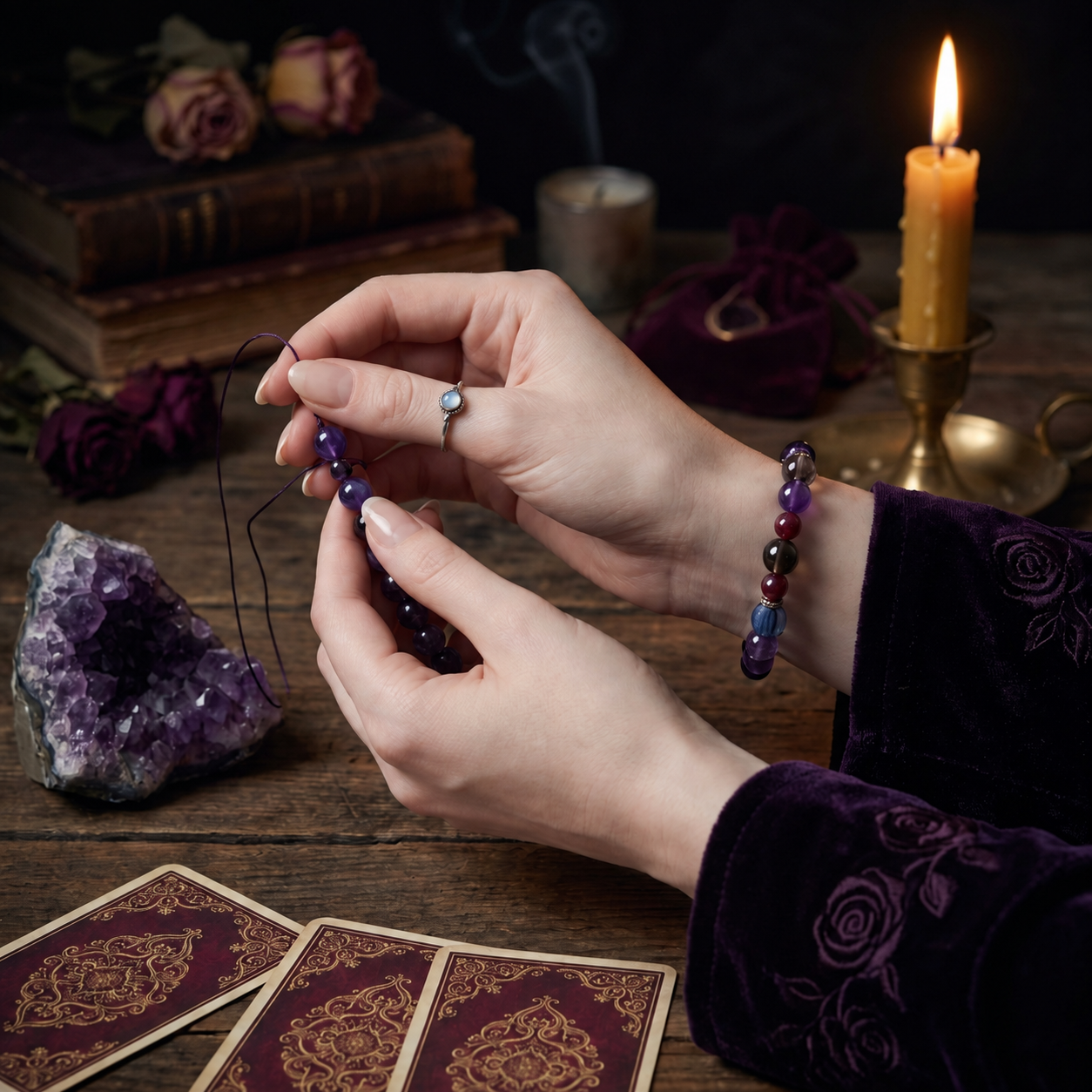
Stone Artistry HISUI is a Japanese witch's atelier tucked into the countryside of Miyagi Prefecture. The atelier crafts dark-romantic crystal bracelets and the Noctéline Oracle tarot — on the surface, a small-batch jewellery brand for lovers of lolita, gothic, witch-aesthetic, and dark-academia.
But the name is older than the brand itself. HISUI — the jadeite word — is the inheritance of a five-thousand-year tradition of treating stones as living things, as vessels of meaning, as the substance the gods reached for first.
When the Witch HISUI strings a bracelet on the night of the full moon, she is not "doing magic." She is doing what jade-workers in this archipelago have done since before recorded history: treating the stone as if it were watching back.
The upcoming Miko Oracle — a 22-deity oracle deck rooted in Shinto mythology — is the most direct expression of this inheritance. The deities of Amaterasu, Tsukuyomi, Susanoo, and the eight million kami were the ones who, in myth, first held the jade beads. The atelier brings their voices into a deck.
Five thousand years ago, someone at Itoigawa drilled the first hole through the first jade comma-bead. Tonight, the HISUI atelier strings the next one.
"The mirror reflects truth.
The sword cuts through illusion.
The jade — the jade simply is.
It is the soul made stone."
Hisui (翡翠) is the Japanese word for jadeite — the green gemstone that Japanese hands have worked for 5,000 years since the Jōmon era. The two kanji that make up the word originally referred to the male (翡) and female (翠) kingfisher, a bird whose iridescent green-blue plumage shifts with the light. Hisui was designated the National Stone of Japan in 2016.
Jade is a general term used commercially for two scientifically distinct minerals: jadeite (硬玉) and nephrite (軟玉). Jadeite is a sodium aluminium silicate (NaAlSi₂O₆) with a Mohs hardness of 6.5–7. Nephrite is a calcium magnesium iron silicate that is slightly softer (Mohs 6–6.5). The jade of Japan — the hisui of Itoigawa — is jadeite, the rarer and more valued of the two. Japan's National Stone designation specifically refers to jadeite.
On 24 September 2016, the Japan Association of Mineralogical Sciences formally designated jadeite (specifically the variety found at Itoigawa, Niigata Prefecture) as the National Stone of Japan. The reasoning combined four factors: (1) Itoigawa is the world's oldest known site of jade processing, dating to the Jōmon era roughly 5,000 BCE; (2) jadeite is the material of the Yasakani no Magatama, one of the Three Sacred Treasures of the Imperial Throne; (3) the geological formation at Itoigawa produces jadeite of exceptional quality, including the rare lavender variety; (4) the unbroken cultural tradition from prehistoric ornament to imperial regalia is unique in world history.
Itoigawa jade is the jadeite found in the Hime River and Kotaki Stream basin in Niigata Prefecture, on the Sea of Japan coast. It is the source material for virtually all jade worked in ancient Japan — from Jōmon-era beads (5,000 BCE) to the Yasakani no Magatama. The area was designated a UNESCO Global Geopark in part because of its jade. River-tumbled jade boulders still wash down from the mountains today. The geological formation is over 500 million years old.
Stone Artistry HISUI takes its name directly from the Japanese word for jadeite — hisui (翡翠). The atelier, based in Miyagi Prefecture, crafts dark-romantic crystal bracelets and the Noctéline Oracle tarot. The name invokes the 5,000-year tradition of treating stones as living things, as the substance the Japanese gods reached for first. The brand carries the lineage of Itoigawa jade into contemporary witch-aesthetic jewellery.
Stone Artistry HISUI jewellery — crystal bracelets, the Noctéline Oracle tarot, and the upcoming Miko Oracle deck — is sold through the Japanese platforms BASE, Creema, and minne. International shipping availability varies by platform. Visit the Boutique section of the website for current listings and shipping destinations.
Yes. Hisui has been used as a sacred amulet stone (omamori) in Japan since the Jōmon era, making it one of the world's oldest continuously worn amulet materials. The magatama (comma-shaped bead) form was specifically used for protection, fertility, and connection to the kami (Shinto deities). Today, hisui bracelets and pendants are worn for benevolence, healing, eternal protection, and the sacred feminine — the four energies most strongly associated with the stone in Japanese tradition.
Seven color types, seven powers, cultural meanings, spotting fakes, purification, stone combinations, eight FAQ. A practical knowledge hub, complementing this brand-origin essay.
Open the Hisui Collection Hub →Discover Noctéline Oracle — a Japanese witch's reimagined tarot — and the crystal jewellery that carries the lineage of jade.